Possession of all of these virtues, plus an abundance of hockey brains, his contract was coveted by every team in the league. The Montrealers, knowing Toe’s worth, turned a deaf ear to all offers, and with the start of the 1939-40 campaign, Blake was named Captain of the Montreal Canadiens, and became the key man in building teams which won the league championship four straight seasons,1943-44 through 1946-47. Toe would wear the captain's 'C' for Montrealuntil his retirement in 1948.
the Punch Line
In 1943 he was teamed up with Elmer Lach and Maurice Richard forming one of the league's most dangerous lines, the Punch Line, and went on to lead Montreal to the Stanley Cup later that season. It was the Old Lamplighter's goal
at 9:12 of overtime in game four that gave Montreal a 5-4 win over
Chicago and possession of hockey's ultimate prize. That year he led all
post-season scorers with 7 goals and 18 points. His record
for that playoffs of two points per game went untouched until Wayne
Gretzky took over the NHL record book in the 1980s. In 1944-45, Blake
notched a personal-best 67 points while helping linemate Richard
become the first 50-goal shooter in NHL history. The Habs were a
powerhouse team in the NHL during this time, and Blake was outstanding
at leading the league in post-season play.
In 1946 Blake led all playoff scorers with 7 goals in
9 games to help bring the team its 2nd championship
in three years. That year the veteran winger was also presented
the Lady Byng Trophy for his sportsmanlike play.
An
excerpt from the Weekly Sports News of October 1948 by H.P. Zinck,
presented this performance of Blake: “There was nothing at which he did not excel. He was a strong, fast skater; he could and did pick the corners with his shots; his passing left little to be desired; he was a past-master at both fore and back checking; his services were in demand when his team had the odd-man advantage and he was often pressed into service when his team was short-handed.“
In January of 1948 Blake suffered a broken leg and could not continue to play.
He retired at the conclusion of the season with 235 regular season goals
and 25 playoff markers to his credit.In 1966 Hector "Toe" Blake was elected
to the Hockey Hall of Fame in the Players category.
He immediately accepted a coaching position with the Houston Huskies of the United States Hockey League and a new career in hockey was established.
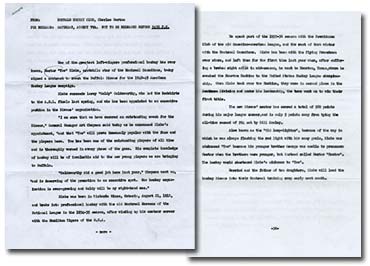
On Saturday, August 7, 1948 a press release from the Buffalo Hockey
Club was sent out announcing that Toe Blake signed a contract to coach
the Buffalo Bisons of the American Hockey League for the 1948-49 campaign.
After a stop at the Montreal AHL affiliate, the Buffalo Bisons, he coached the
Valleyfield Braves in the Quebec Senior Hockey League in the early 1950s.
Then the Canadiens came calling, looking for a new head coach to replace the legendary Dick Irvin.
Blake became the new bench boss in Montreal, and captured the Stanley Cup during his first five seasons with the team.
One of the main reasons he was hired was to help control the explosive temper of his former linemate, Maurice Richard.
Blake had high standards for his team, and his stern approach to coaching paid off handsomely.
With players such as Jean Beliveau, Bert Olmstead, Boom Boom Geoffrion, and Jacques Plante,
Blake’s team won eight Stanley Cups, and finished first nine times during his 13-year tenure.
Blake's performance behind the Montreal bench between 1955 and 1968 was unparalleled. He won an incredible eight Stanley Cup titles in just 13 seasons, including five in a row in his first five years of coaching.
The Last Waltz
 |
The Montreal Canadiens Hockey Club celebrated the reunion of the 1959-60 team members who won the Stanley Cup for a
fifth straight year on Dec. 17, 1983 at the Montreal Forum. From left, Maurice "Rocket" Richard, coach Hector "Toe" Blake,
and goalie Jacques Plante re-enact parading the cup around the ice as they did 23 years before.
|
"The Old Lamplighter"
Toe Blake passed away on May 17, 1995 at the age of 82.
A Fond Farewell
Let's Raise Toe Blake's #6 to the Rafters of the Bell Center


 Born in Victoria Mines, outside of Sudbury, Ontario in August of 1912,